



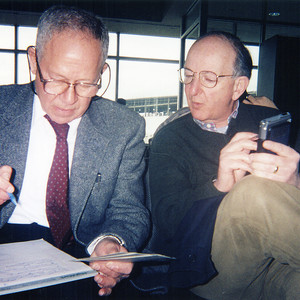

Ralph L. Rosnow
Fully scanned copies of the following five books are openly accessible here for free downloading. Simply click "Images and Files" tab (above), scroll down and click on the title.
(1) Paradigms in Transition: The Methodology of Social Inquiry (Rosnow, 1981)
(2) People Studying People: Artifacts and Ethics in Behavioral Research (Rosnow & Rosenthal, 1997)
(3) Essentials of Behavioral Research: Methods and Data Analysis (3rd edition) (Rosenthal & Rosnow, 2008)
(4) Rumor and Gossip: The Social Psychology of Hearsay (Rosnow & Fine, 1976)
(5) Writing Papers in Psychology: Proposals, Research Papers, Literature Reviews, Poster Presentations and Concise Reports" (9th edition) (Rosnow & Rosnow, 2012)
How people make sense of things and justify their conclusions have long been of interest to me. Research methods, analyses of research data, and related issues (such as conflicts between ethical and methodological principles) all are of interest to me. I am also interested in contexts of discovery (qualitative and quantitative) and justification. As contexts need contents, among those in social psychology that my students and I explored and wrote about are persuasion and opinion change, impression formation and stereotyping, rumor and gossip, and interpersonal acumen.
From 1960-62, I was a Ph.D. student in psychology at The American University in Washington, D.C. I had the good fortune to work with Robert E. Lana, then an associate professor of psychology and statistics. In his experimental studies, he was using a method of analysis described by experimental psychologist Richard Solomon in his exploratory work on pretest sensitization. Lana's application of Solomon's design when the pretest involved opinions or attitudes whetted my interest. Thinking about a topic for my doctoral study, I recalled an idea of R. L. Thorndike's in the 1930s. Thorndike theorized that the bolstering effects of a reward (or "satisfying state of affairs") could spread forward and backward. For my study, I simulated the notion of the "spread of effect" of coincidentally induced affect on opinion change responses to communications temporally contiguous with the source of affect. Results were consistent with theory, and in subsequent research I would pursue variations of this notion.
With Ph.D. in hand, I remained in Washington for several months more, while I figured out what to do next. I was a Lieutenant in the Army Reserves, and the comradery and experience were teaching me much. I found challenging little tasks in applied social psychology in D.C. One involved an apparatus and procedure for recording responses. The popular existing apparatus consisted of two push-button-response devices, one for each hand (e.g., yes-no, good-bad). As a way of widening the response range from dichotomous to continuous, I sketched a box open at one end with a levered device inside. In one room, the respondents and stimulus exist, each respondent with his or her own levered box. For unobtrusive observers in another room, there would be a panel of meters, one for each respondent, and paper records could also be made. The idea was accepted, and once it was developed, I tried it out and it worked. Several years later, I thought it might be of interest to others interested in sources of artifacts. If so, the paper is titled Bias in Evaluating the Presidential Debates: A "Splinter" Effect, and it's in the Journal of Social Psychology, 1965, 67, 211-219.
It was easy for me to figure out what to do next: propose to Mimi (Marion Quin). She said yes. I had a job lined up in Boston as an assistant professor of communication research at Boston University. Mimi had graduated from Wheaton College in Norton, Massachusetts. She had been editor of her college newspaper, and she was eager to edit my writing. We were married in August 1963, and for our honeymoon, we drove to Norwood, Massachusetts, where a small garden apartment was awaiting us. At BU, the chairman of the program in which I would be teaching research methods, statistics, and social psychology (from 1963-67) was Edward J. Robinson. He was enthusiastic, amiable, and had a clear vision for the new graduate-level program. Teaching at BU greatly expanded my own sphere of experience, and Ed and I collaborated on "Experiments in Persuasion," my first published book.
The early 1960s was also when Bob Rosenthal began his Boston teaching and research career. We met, became friends, and I invited him to join me in some exploratory research on volunteer subject bias. He had written a conceptual paper on the subject. I had completed an exploratory study of volunteer bias (inspired by Martin Orne's "good subject" concept in his work on demand characteristics), but I had not yet submitted the results to a journal. It would be our first published work together. For over 50 years, our friendship grew. We collaborated on many books (see Publications), research studies, journal papers, and invited chapters. When Bob Rosenthal was scheduled to be on sabbatical leave at Harvard, I was invited to teach his research methods course and my own open seminar course in social psychology. In 1999, Bob and MaryLu Rosenthal moved from Lexington, Massachusetts to Riverside, California. Bob had a teaching appointment as Distinguished Professor (then as University Professor) at University of California, Riverside. (Our long collaboration was uninterrupted by distance.)
In 1967, Bob Lana, who had moved to Philadelphia and Temple University, invited me to join him in developing a new doctoral program in social psychology. The cold winter weather in New England had gotten to me. Temple offered me an enticing appointment as an associate professor, Bob and I were good friends, and both Mimi and I liked Philly. It was not far from Long Beach Island, where we all would spend summer weeks in Surf City together. I happily accepted the Temple University offer. In 1970, I was promoted to professor. Bob Lana was then the second professor at Temple to hold the Thaddeus Lincoln Bolton Professorship. When Bob became dean of the graduate school, he relinquished the named chair, and the president of the university passed it to me. Bolton, born in 1865, earned the Ph.D. in psychology at Clark University, the first to receive that Ph.D. in this country. Clark University was where G. Stanley Hall was president, and Hall's view of psychology was that it was a science on a par with biology, chemistry, physics, and mathematics. In 1924, Bolton started the department of psychology at Temple University.
When I was a kid, growing up in East Baltimore, I accidentally slipped backwards into a pickle barrel in a Lombard Street deli when I was mesmerized by the lightning speed of the man behind the cash register seemingly doing tricks with numbers. Wet with pickle juice did not diminish my curiosity for numbers and virtually everything else. Bob Lana and Bob Rosenthal reinforced those interests and, by their own examples, further enlarged my sphere of interests. In August 2006, Bob Lana died, and he is missed by those of us who remain. MaryLu Rosenthal died in 2010, and Bob Rosenthal and I filled his loneliness by making a habit of chatting every Saturday, enjoying one another's company and reminiscing about the old days and projects we never got around to completing. We always concluded with upbeat expectations (the "Rosenthal effect" for lifting spirits). Bob Rosenthal died in January 2024, and he is sorely missed.
Primary Interests:
- Applied Social Psychology
- Attitudes and Beliefs
- Interpersonal Processes
- Research Methods, Assessment
- Social Cognition
Note from the Network: The holder of this profile has certified having all necessary rights, licenses, and authorization to post the files listed below. Visitors are welcome to copy or use any files for noncommercial or journalistic purposes provided they credit the profile holder and cite this page as the source.
Image Gallery
Other Files
Books:
- 1967. Experiments in Persuasion (R. L. Rosnow & E. J. Robinson, Eds.). Academic Press.
- 1972. Introduction to Contemporary Psychology (R. E. Lana & R. L. Rosnow). Holt, Rinehart & Winston. (Contributors included: Leona Aiken, Ronald Baenninger, Russell Eisenman, Jeffrey H. Goldstein, D. J. King, J. H. McCroskey, Howard Wainer, Herbert Weissman.)
- 1975. The Volunteer Subject (R. Rosenthal & R. L. Rosnow). Wiley-Interscience.
- 1976. Rumor and Gossip: The Social Psychology of Hearsay (R. L. Rosnow & G. A. Fine). Elsevier. (Copyright reverted to Rosnow and Fine.)
- 1981. Paradigms in Transition: The Methodology of Social Inquiry (R. L. Rosnow). Oxford University Press. (Copyright reverted to Rosnow.)
- 1984. Understanding Behavioral Science: Research Methods for Research Consumers (R. L. Rosnow & R. Rosenthal). McGraw Hill.
- 1985. Contrast Analysis: Focused Comparisons in the Analysis of Variance (R. Rosenthal & R. L. Rosnow). Cambridge University Press.
- 1986. Contextualism and Understanding in Behavioral Science: Implications for Research and Theory (R. L. Rosnow & M. Georgoudi, Eds.). Praeger. (Contributors included: I. Altman, T. O. Blank, R. A. Dixon, J. S. Efran, M. Georgoudi, G. Gerbner, C. K. Germer, R. E. Lana, J. V. Lerner, R. M. Lerner, M. D. Lukens, W. J. McGuire, G. E. McKechnie, J. Meyowitz, J. G. Morawski, T. R. Sarbin, J. Shotter, and J. Veroff.)
- 1997. People Studying People: Artifacts and Ethics in Behavioral Research (R. L. Rosnow & R. Rosenthal). W. H. Freeman. (Copyright reverted to Rosnow and Rosenthal.)
- 2000. Contrasts and Effect Sizes in Behavioral Research: A Correlational Approach (R. Rosenthal, R. L. Rosnow, & D. B. Rubin). Cambridge University Press.
- 2008. Essentials of Behavioral Research: Methods and Data Analysis, 3rd edition (R. Rosenthal & R. L. Rosnow). McGraw-Hill. (Copyright reverted to Rosenthal and Rosnow.)
- 2009. Artifacts in Behavioral Research: Robert Rosenthal and Ralph L. Rosnow's Classic Books (Foreword by A. E. Kazdin). Oxford University Press.
- 2013. Beginning Behavioral Research: A Conceptual Primer, 7th edition (R. L. Rosnow & R. Rosenthal). Pearson.
Journal Articles:
- 1968. Adding versus averaging as a stimulus-combination rule in forming impressions of groups (R. L. Rosnow & R. L Arms). Journal of Personality and Social Psychology, 10, 363-369).
- 1989. Statistical procedures and the justification of knowledge in psychological science (R. L. Rosnow & R. Rosenthal). American Psychologist, 44, 1276-1284.
- 1991. Inside rumor: A personal journey (R. L. Rosnow). American Psychologist, 46, 484-496.
- 1994. Intelligence and the epistemics of interpersonal acumen: Testing some implications of Gardner's theory (R. L. Rosnow, A. A. Skleder, M. E. Jaeger, & B. Rind). Intelligence, 19, 93-116.
- 1995. "Some things you learn aren't so": Cohen's paradox, Asch's paradigm, and the interpretation of interaction (R. L. Rosnow & R. Rosenthal) Psychological Science, 6, 3-9.
- 1996. Computing contrasts, effect sizes, and counternulls on other people's published data: General procedures for research consumers (R. L. Rosnow & R. Rosenthal). Psychological Methods, 1, 331-340.
- 1996. Contrasts and interactions redux: five easy pieces (R. L. Rosnow & R. Rosenthal). Psychological Science,7(4),253-257.
- 1997. Hedgehogs, foxes, and the evolving social contract in psychological science: Ethical challenges and methodological opportunities (R. L. Rosnow). Psychological Methods, 2, 345--356.
- 2000. Contrasts and correlations in effect-size estimation (R. L. Rosnow, R. Rosenthal, & D. B. Rubin). Psychological Science, 11, 446-453.
- 2003. Effect sizes for experimenting psychologists (R. L. Rosnow & R. Rosenthal). Canadian Journal of Experimental Psychology, vol. 57, pp. 221-237. Formula noted in Table 1 should read: 1/2*loge[(1+r)/(1-r)].
- 2009. Effect sizes: Why, when, and how to use them (R. L. Rosnow & R. Rosenthal). Zeitschrift fur Psychologie/Journal of Psychology, 217(1), 6-14.
Other Publications:
- 1968. A "spread of effect" in attitude formation (R. L. Rosnow). In A. G. Greenwald, T. C. Brock & T. M. Ostrom (Eds.), Psychological Foundations of Attitudes (pp. 89-107). Academic Press.
- 1970. Volunteer effects in behavioral research (R. L. Rosnow & R. Rosenthal). In T. M. Newcomb (Ed.), New Directions in Psychology 4 (pp. 211-277). Holt, Rinehart & Winston.
- 2001. Rumor and gossip in interpersonal interaction and beyond: A social exchange perspective (R. L. Rosnow). In R. M. Kolwalski (Ed.), Behaving Badly: Aversive Behaviors in Interpersonal Relationships (pp. 203-232). American Psychological Association Press.
- 2007. Assessing the effect size of outcome research (R. L. Rosnow & R. Rosenthal). In A. M. Nezu & C. M. Nezu (Eds.), Evidence-based Outcome Research: A Practical Guide to Conducting Randomized Controlled Trials for Psychological Interventions (pp. 379-401). Oxford University Press.
- 2011. Ethical principles in data analysis (R. L. Rosnow & R. Rosenthal). In A. Panter & S. K. Sterba (Eds.), Handbook of Ethics in Quantitative Methodology (37-58), Routledge Academic.
- 2013. Ethics and quantitative methods (R. L. Rosnow & R. Rosenthal). In T. D. Little (Ed.), Oxford Handbook of Quantitative Methods (Vol. 1, pp. 31-53). Oxford University Press.
Courses Taught:
- Graduate Course in Data Analysis
- Graduate Course in Research Methods
- Graduate Seminar on Social Psychology
- Undergraduate Course in Research Methods
Ralph L. Rosnow
Pennsylvania
United States of America
